

The Case for Abacus Classes for Kids in an Age of Instant Answers
Nine-year-old Priya used to freeze at homework time. The moment a math problem showed up, her hand went straight for a calculator — or she'd ask a smart speaker to do it for her, sometimes before she'd even finished reading the question. Her parents noticed the pattern building over a few months: less patience for working through a problem, more reliance on whatever device was nearest. It led them to a question a lot of families are asking right now: if AI and apps solve everything instantly, will my child ever learn to think through a problem on their own?
It's a fair worry. It's also why searches for abacus classes for kids and abacus online classes have stayed steady even as "AI homework help" tools have exploded. Parents aren't looking for another app — they're looking for something that builds the thinking muscle apps let kids skip.
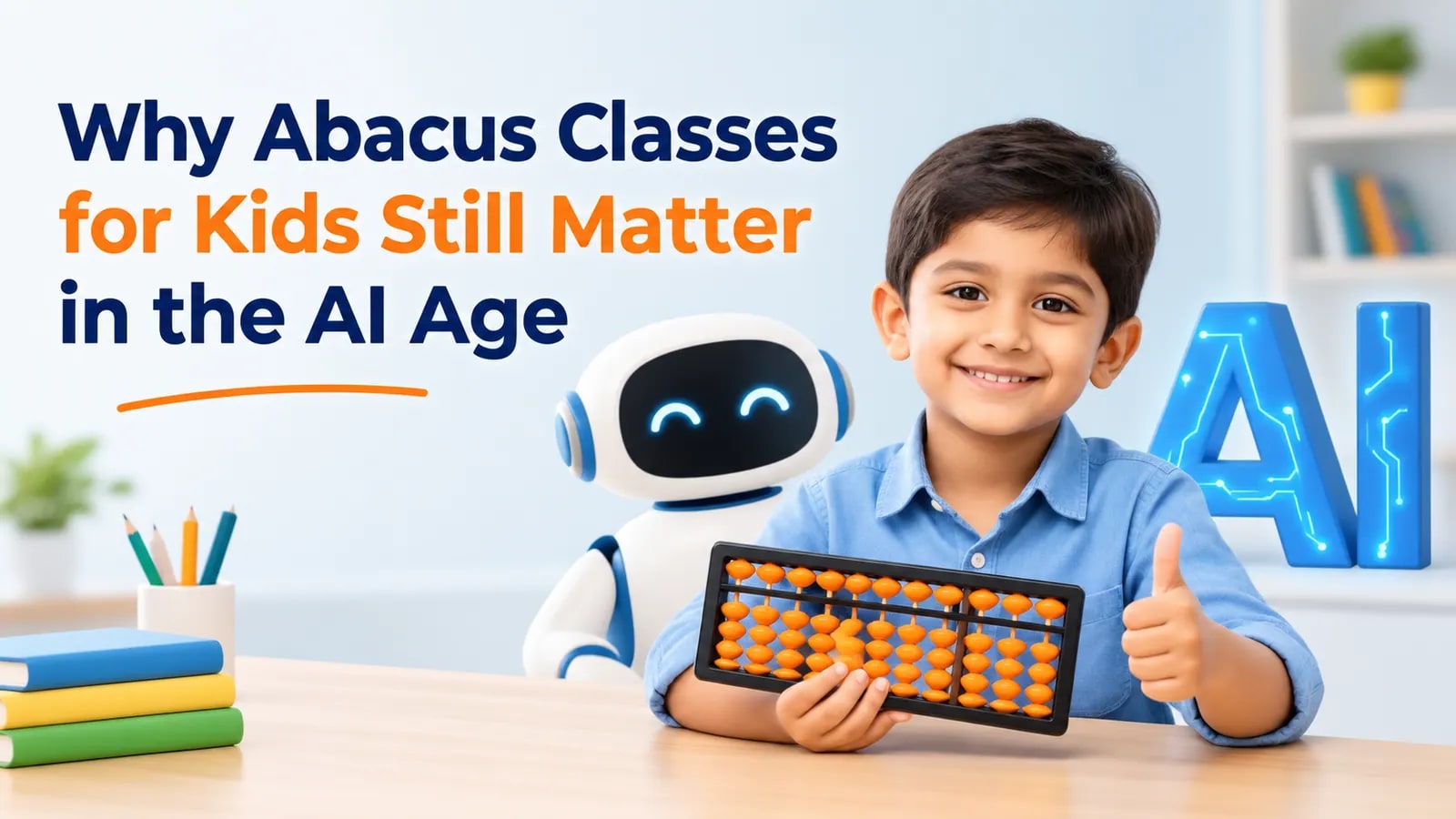
The Real Problem: Instant Answers, Undeveloped Skills
Today's kids have less friction between "I have a question" and "I have an answer" than any generation before them. That's useful for looking things up. It's less useful for math, where the process of working through a problem is the actual skill being built.
A few patterns parents and teachers report:
Kids reach for a calculator for sums they could do in their head with a bit of practice
Shrinking attention spans from constant notifications make it harder to sit with a problem
Low confidence in math shows up early, often before a child has actually struggled with the material
A "just Google it" reflex replaces the habit of trying first
None of this means technology is bad. It means kids need at least one activity where the tool is their own brain.
What Abacus Training Actually Does and Why Abacus Classes for Kids Still Matter in the AI Age
It's worth being precise here, because this space has a habit of overselling. Abacus training doesn't "rewire the brain" or reliably boost IQ — that claim shows up a lot in marketing and isn't well supported. What's better supported, and what teachers and parents consistently observe, is more modest and still genuinely useful:
Faster, more confident mental calculation — children move from a physical abacus to visualizing the beads mentally (mental abacus), eventually solving multi-digit sums in their head
Stronger working memory from holding a mental image of bead positions while calculating
Better sustained focus, since the method requires tracking numbers continuously with no shortcut
A "figure it out myself" habit — the opposite instinct from reaching for an AI tool, which matters most in an AI-saturated world
Abacus vs. Traditional Math Drills
Traditional math practice often leans on repetition and memorized formulas, which works for some kids and burns out others. Abacus training uses visualization instead of rote memorization: children build a mental picture of the calculation rather than recalling a rule. For a child who's checked out of math because it feels like memorizing facts, this can be a genuinely different entry point — not a replacement for school math, but a complement to it.
Most instructors recommend starting between age 5 and 6, once a child can recognize numbers up to 100 and sit focused on one task for 15–20 minutes. Start much earlier and a child is just moving beads without building the mental model; start much later (mid-teens) and most kids have already covered the ground the abacus is meant to build.
Priya's Progress
A few months into structured abacus practice, Priya's parents noticed a shift that had nothing to do with speed. She stopped reaching for the calculator by default and started attempting problems first — sometimes getting them wrong, sometimes right, but trying either way. Her teacher noted better focus during class. Her parents put it simply: "She used to avoid math homework. Now she asks to do it first."
That's really the outcome worth optimizing for — not a faster calculator, but a kid willing to try before outsourcing the thinking. Read more about Abacus here Abacus classes for kids: Benefits, Right Age, and What to Expect
Orphosys Team
Editorial team at Orphosys Foundation, dedicated to brain development and academic excellence.
Discussion (0)
Be the first to share an insight